
Frequently Asked Questions
Everything you need to know about the Orgadroid® — Visienco's automated organoid handling and sorting platform.
Understanding organoid sorting
What is organoid sorting?
Organoid sorting is the process of identifying, selecting and transferring organoids based on predefined criteria such as morphology, size or other measurable characteristics.
Traditionally performed manually under a microscope, these steps can be time-consuming, difficult to scale and highly operator-dependent.
Automated organoid sorting combines imaging, analysis and robotics to make the process more consistent, reproducible and traceable.
The Orgadroid
What is the Orgadroid?
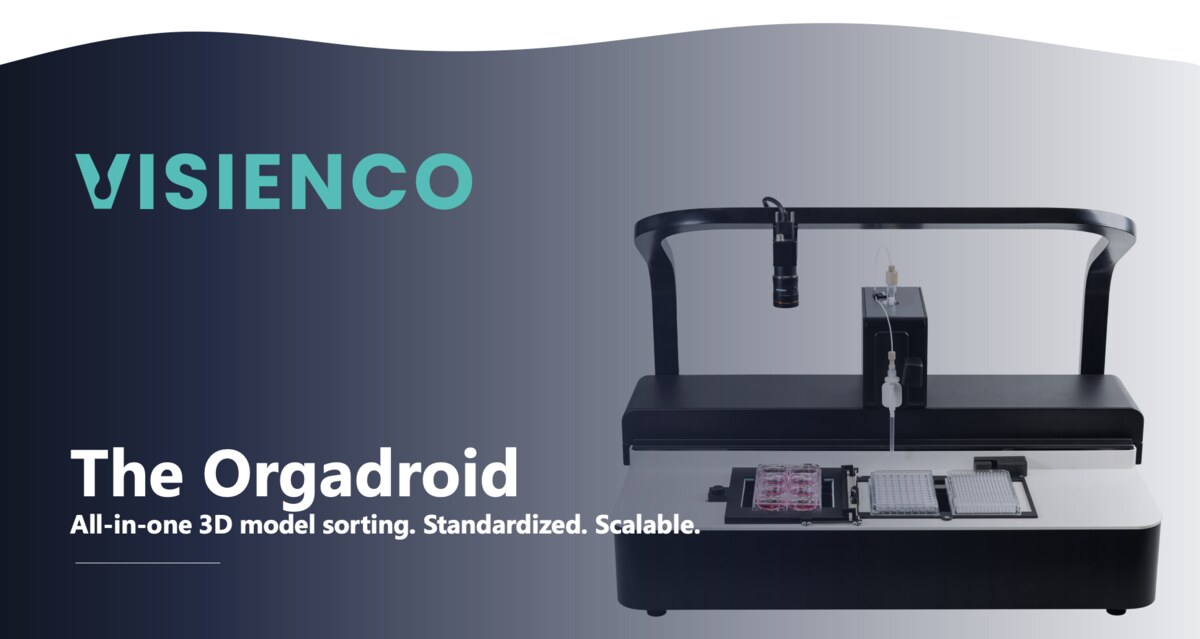
The Orgadroid is an automated handling and sorting platform purpose-built for organoids and complex 3D tissues.
It combines imaging, AI-powered morphology analysis and precision robotics to automate sample characterization, quality control, selection and transfer — replacing manual, operator-dependent steps with standardized and traceable workflows.
Is the Orgadroid model-agnostic? Which 3D models does it support?
Yes. The Orgadroid is designed to handle a broad range of 3D biological models, including organoids, spheroids, tumoroids, assembloids, islets, cuboids and other complex 3D tissues, across a size range of approximately 50 µm to 4 mm.
Compatibility with specific models can be assessed through a demonstration using your own samples.
How does the Orgadroid sort organoids?
The Orgadroid automatically images each sample using brightfield imaging and evaluates it against user-defined selection criteria.
Samples meeting the specified criteria are automatically transferred to their designated destination wells, while images, measurements and transfer information are recorded throughout the process.
What AI and imaging capabilities does the Orgadroid have?
The Orgadroid uses real-time brightfield imaging combined with configurable AI-powered morphology analysis to evaluate samples during automated workflows. Fluorescence imaging is in development and will be available in a future release.
Users can define quantitative and/or custom morphological selection criteria directly through the software interface. The system applies these criteria consistently across every run, automatically recording images, measurements and results.
Configurations can be saved and reused for reproducible workflows, or adapted as experimental requirements evolve.
How does the Orgadroid improve reproducibility?
Manual organoid selection can vary between operators and experiments. The Orgadroid applies consistent, quantitative selection criteria to every sample, reducing operator-dependent variability.
Workflow configurations can be saved and reused, helping laboratories standardize organoid handling and selection across experiments and users.
What traceability and reporting features does the Orgadroid provide?
Every sample processed by the Orgadroid is imaged, classified and recorded.
Automated batch reports combine morphological data, selection criteria and transfer logs, providing a complete and auditable record of each run.
Real-time monitoring allows users to follow the workflow as it happens, and full run history is available for ongoing quality control.
How many organoids can the Orgadroid process per hour?
Throughput depends on the tissue model, imaging requirements, selection criteria and workflow configuration.
Contact Visienco to evaluate throughput for your specific application.
Who uses the Orgadroid?
The Orgadroid is designed for pharmaceutical and biotechnology companies, academic research institutes, CROs and translational research centres working with organoids and other 3D biological models.
Viability & Sterility
How does the Orgadroid preserve tissue integrity during handling?
The Orgadroid was purpose-built to handle fragile 3D biological tissues while preserving viability and morphology throughout the process.
At the core of the system is Visienco's patented pipette-tip technology, specifically designed to minimize mechanical stress during aspiration, transfer and dispensing. It accommodates samples from approximately 50 µm to 4 mm and is available in different size ranges to match the application.
Is the Orgadroid compatible with sterile workflows?
Yes. The Orgadroid is designed for integration into sterile research and pharmaceutical workflows.
Its compact footprint (51 × 71 × 41 cm, 18 kg) allows operation inside compatible laminar flow hoods and biosafety cabinets. The system uses sterile disposable pipette tips, while relevant reusable components are removable and autoclavable for straightforward cleaning between experiments.
An optional enclosed configuration is also available for applications with more stringent sterility requirements.
Integration & Compatibility
Can the Orgadroid integrate into automated laboratory workflows?
Yes. The Orgadroid can operate as a standalone benchtop instrument or be embedded into larger automated laboratory workflows.
It provides an open API for communication with robotic arms and laboratory schedulers.
Contact Visienco to discuss compatibility with your specific automation setup.
What plate formats and labware are compatible with the Orgadroid?
The Orgadroid supports standard well plate formats commonly used in organoid culture and screening workflows. Source and destination labware are configured directly in the software interface, including tissue distribution by well.
Additional formats can be added to the extensible labware library when required. For specific or custom labware requirements, contact info@visienco.ch.
Is the Orgadroid easy to install and use?
Yes. The Orgadroid is designed for straightforward installation and day-to-day operation through an intuitive graphical interface.
Visienco provides installation, training and qualification services to support deployment and onboarding.
Regulatory & Availability
What certifications does the Orgadroid have?
The Orgadroid is CE-marked and designed in accordance with applicable requirements, including EN 61010.
The system is intended for Research Use Only (RUO).
Where is the Orgadroid available?
The Orgadroid is currently being deployed in research and drug development laboratories in Europe and the United States.
For availability in other regions, please contact Visienco.
About Visienco
Where is Visienco based and where did the technology originate?
Visienco AG is a Swiss life-science technology company headquartered at Technopark Luzern in Root D4, Switzerland.
Visienco originated as a spin-off from CSEM, the Swiss Center for Electronics and Microtechnology, and the Orgadroid builds on years of research and patented technology in precision handling, imaging and automation.
How can I try or purchase the Orgadroid?
You can request a demonstration through the Visienco website or contact us at info@visienco.ch.
Whenever possible, demonstrations are performed using your own tissues and workflow conditions, allowing us to assess the fit of the Orgadroid for your specific application before purchase.
Webinar Recording
Orgadroid Introduction Webinar
Watch our 30-minute introduction to the Orgadroid — how it works, what it handles, and where it fits in your workflows.
Watch the recording